

前几天我的 ESP32-S3-N16R8 不是到了嘛,尝试搞了点常规的操作,我正在想还可以干啥比较有意思的,毕竟这玩意本质上就是一个计算机。
然后,我脑子里面出现了一个疯狂的想法——让 ESP32-S3-N16R8 运行 Typecho
当时和 ChatGPT 讨论的时候,只是试探性玩笑地问了一句:
我有一个疯狂的想法:能在这玩意上面运行 typecho 吗?
没想到的是,他居然回复了:
你这个想法居然不是完全不可能!而且我查到了一个相当惊人的项目:已经有人把真正的 PHP 解释器移植到了 ESP32-S3 上。
而这个项目,正是 php-esp32,最重要的是,这个项目支持两个 ESP32 的开发板:ESP32-S3 和 ESP32-P4 ,而我买的 ESP32-S3-N16R8 正好就在支持列表里面!果然多花的 10 块钱没有白花,这次可以整狠活了
还有什么好说的?直接开整!
备份开发板
因为我还是希望保留原厂的 MicroPython 环境进行后续的学习,所以我打算对开发板进行备份,整完了活之后再刷回去。有了上一篇文章时的入门基础,现在操作就熟悉多了。
开始备份:
python -m esptool \
  --chip esp32s3 \
  --port /dev/ttyACM0 \
  --baud 460800 \
  read_flash 0x0 0x1000000 esp32s3_original_16mb.bin
这里建议进行第二次备份以防万一,备份完成后校验一下两个文件的哈希:
python -m esptool \
  --chip esp32s3 \
  --port /dev/ttyACM0 \
  --baud 460800 \
  read_flash 0x0 0x1000000 esp32s3_verify_16mb.bin

cmp esp32s3_original_16mb.bin esp32s3_verify_16mb.bin
不过有一说一,这个备份真的慢,16MB 的数据传输了差不多10分钟,感觉回到了上古计算机时代。
准备 PHP 编译环境
这里最好是使用 ext4 或 Btrfs 等 Linux 文件系统,以防万一 ESP-IDF 的符号链接、文件权限和编译执行遇到问题。
创建一个你喜欢的项目文件夹名称,进入项目文件夹,创建工具目录:
mkdir -p tools toolchains下载 phpflash:
curl -fL \
  https://github.com/php-baremetal/flash-tool/releases/latest/download/phpflash-linux-amd64 \
  -o tools/phpflash

chmod +x tools/phpflash

./tools/phpflash --version
这是 php-esp32 官方推荐的构建管理工具,负责创建工程、调用 ESP-IDF 编译、烧录和串口监控。
安装 ESP-IDF 和 PHP 移植源码:
export IDF_TOOLS_PATH="$PWD/toolchains/.espressif"

./tools/phpflash system-setup \
  --idf-path "$PWD/toolchains/esp-idf" \
  --php-esp32-path "$PWD/toolchains/php-esp32"
这会下载乐鑫 ESP-IDF、ESP32 交叉编译器,以及 php-esp32 的源码,并获取官方 PHP 源码进行移植构建准备。这套编译环境大概会占据 7GB ~ 8GB 的磁盘空间,请注意一下可用空间够不够(应该还是有这点空间的吧?)。
创建局部的项目环境变量,新建 env.sh 文件,内容如下:
export ROOT="/run/media/chocola/3T-DATA02/Projects/ESP32/Typecho_on_ESP32"

export IDF_TOOLS_PATH="$ROOT/toolchains/.espressif"
export IDF_PATH="$ROOT/toolchains/esp-idf"
export PHP_ESP32_DIR="$ROOT/toolchains/php-esp32"

echo "PHP-on-ESP32 environment loaded."
/run/media/chocola/3T-DATA02/Projects/ESP32/Typecho_on_ESP32 记得替换成你实际的项目文件夹路径,后续导入开发环境只需要:
source env.sh尝试编译第一个 PHP 固件
饭要一口一口吃,测试也要一步一步来。第一步需要先验证这套开发环境是否有效,我们先不要放 Typecho,第一个目标应该是:
让 ESP32-S3 上电后执行真正的 PHP 代码,并通过串口输出 Hello World。
创建项目目录:
./tools/phpflash init php-hello按照下面的方式进行选择:
Project name [php-hello]:
Chip:
  1) ESP32-P4 (esp32-p4)
  2) ESP32-S3 (esp32-s3)
choice [1]: 2
Board preset:
  1) Espressif ESP32-S3-DevKitC-1 (N16R8) (espressif-esp32-s3-devkitc-1-n16r8)
  2) Espressif ESP32-S3-DevKitC-1 (N8R2) (espressif-esp32-s3-devkitc-1-n8r2)
  3) Espressif ESP32-S3-DevKitC-1 (N8R8) (espressif-esp32-s3-devkitc-1-n8r8)
  4) ESP32-S3 (octal PSRAM, generic) (generic)
  5) ESP32-S3 (quad PSRAM, generic) (generic)
  6) Waveshare ESP32-S3-ETH (waveshare-esp32-s3-eth)
  7) Waveshare ESP32-S3-Touch-LCD-1.85B (waveshare-esp32-s3-touch-lcd-1.85b)
  8) Waveshare ESP32-S3-Zero (waveshare-esp32-s3-zero)
  9) Waveshare ESP32-S3-Zero (N8R8) (waveshare-esp32-s3-zero-n8r8)
choice [1]: 1
Storage type:
  1) embedded
choice [1]:
Project type:
  1) init-loop
  2) web-server
  3) event-driven
choice [1]: 1
PHP version:
  1) 8.3.32
  2) 8.3.33
  3) 8.4.24
  4) 8.4.25 (default)
  5) 8.5.10
  6) 8.5.9
choice [4]:
Optional extensions (comma-separated numbers, empty = none):
  1) date — Real ext/date: the DateTime class and the date/time API (a UTC stub covers the core when off).
  2) ctype — Character-class checks (ctype_alpha, ctype_digit, ...).
  3) filter — filter_var() validation and sanitization.
  4) tokenizer — The PHP tokenizer: token_get_all(), token_name(), the PhpToken class and the T_* constants, over the engine's own lexer. Wanted by frameworks and static-analysis tools.
  5) session — Sessions: session_start(), $_SESSION, session_id(), and save handlers -- the files handler (point session.save_path at a writable dir like the microSD) and user handlers (session_set_save_handler).
  6) opcache — Zend OPcache (no JIT): compiled bytecode is cached so each request skips re-tokenizing/compiling the sources -- a big win for frameworks where the per-request cost is compilation. Default is file-cache on the microSD (bytecode on the card, full PSRAM free for the request); see the in_memory setting.
  7) mbstring — Multibyte strings (mb_strlen/substr/convert/detect/...). Built without mb_ereg unless the onig setting is on.
  8) openssl — The openssl_* functions. Default is a small mbedTLS-backed subset (symmetric AES: openssl_encrypt/decrypt, cipher_iv_length, random_pseudo_bytes) -- enough for e.g. Laravel's Encrypter. The `full` setting builds the real ext/openssl instead (RSA/X.509/...). See docs/openssl.md.
  9) sqlite — SQLite: read/write .db files. Default API is PDO (ext/pdo + pdo_sqlite); the 'sqlite3' type selects the SQLite3-class API instead (~45 KB smaller, no PDO).
  10) led — Addressable LEDs from PHP: Baremetal\Led\Driver\* (WS2812, SK6812) + the Output\Led capability. Pin and pixel count are passed at construction.
  11) wifi — WiFi from PHP: scan/join a network (STA) and create one (SoftAP). WiFi-capable SoCs only (not the ESP32-P4).
  12) i2c — I2C from PHP: Baremetal\I2c\Bus and \Device (scan/probe/read/write/readReg/writeReg), with a driver framework. Pins are passed at construction.
  13) spi — SPI/QSPI from PHP: Baremetal\Spi\Bus and \Device (transfer/write/read), plus the Output\Display capability and framebuffer panel drivers. Pins are passed at construction.
  14) web — HTTP server from PHP in the event-driven model: Baremetal\Http\Request/\Response + serve_http(). Requests arrive as Request events; the handler returns a Response. Needs a board with a network.
choices:
Serial port (empty = autodetect) []:
Starter PHP:
  1) hello
  2) blink
choice [1]:
created php-hello/php-baremetal.config.toml

Next: cd php-hello && phpflash build
下一步,编译!
cd php-hello
../tools/phpflash build
等待编译完成后,烧录进 ESP32:
../tools/phpflash flash -p /dev/ttyACM0注意检查不要让别的程序占用 TTY ,TTY 只能被一个程序占用,如果有别的程序占用,烧录会报错。
烧录完成后,连接 TTY 查看启动信息:
../tools/phpflash monitor -p /dev/ttyACM0看到启动信息如下,说明就成功了:
I (24) boot: ESP-IDF v5.5.5 2nd stage bootloader
I (25) boot: compile time Oct 31 2026 12:23:36
I (25) boot: Multicore bootloader
I (25) boot: chip revision: v0.2
I (28) boot: efuse block revision: v1.4
I (31) boot.esp32s3: Boot SPI Speed : 80MHz
I (35) boot.esp32s3: SPI Mode       : DIO
I (39) boot.esp32s3: SPI Flash Size : 16MB
I (43) boot: Enabling RNG early entropy source...
I (47) boot: Partition Table:
I (50) boot: ## Label            Usage          Type ST Offset   Length
I (56) boot:  0 nvs              WiFi data        01 02 00009000 00006000
I (63) boot:  1 phy_init         RF data          01 01 0000f000 00001000
I (69) boot:  2 factory          factory app      00 00 00010000 00fd0000
I (76) boot:  3 storage          Unknown data     01 81 00fe0000 00020000
I (82) boot: End of partition table
I (86) esp_image: segment 0: paddr=00010020 vaddr=3c1f0020 size=bfa48h (784968) map
I (236) esp_image: segment 1: paddr=000cfa70 vaddr=3fc94b00 size=005a8h (  1448) load
I (237) esp_image: segment 2: paddr=000d0020 vaddr=42000020 size=1ef420h (2028576) map
I (610) esp_image: segment 3: paddr=002bf448 vaddr=3fc950a8 size=048ach ( 18604) load
I (614) esp_image: segment 4: paddr=002c3cfc vaddr=40374000 size=10ac0h ( 68288) load
I (630) esp_image: segment 5: paddr=002d47c4 vaddr=50000000 size=00020h (    32) load
I (637) boot: Loaded app from partition at offset 0x10000
I (637) boot: Disabling RNG early entropy source...
I (648) octal_psram: vendor id    : 0x0d (AP)
I (648) octal_psram: dev id       : 0x02 (generation 3)
I (649) octal_psram: density      : 0x03 (64 Mbit)
I (651) octal_psram: good-die     : 0x01 (Pass)
I (655) octal_psram: Latency      : 0x01 (Fixed)
I (659) octal_psram: VCC          : 0x01 (3V)
I (663) octal_psram: SRF          : 0x01 (Fast Refresh)
I (668) octal_psram: BurstType    : 0x01 (Hybrid Wrap)
I (673) octal_psram: BurstLen     : 0x01 (32 Byte)
I (678) octal_psram: Readlatency  : 0x02 (10 cycles@Fixed)
I (683) octal_psram: DriveStrength: 0x00 (1/1)
I (687) MSPI Timing: Enter psram timing tuning
I (692) esp_psram: Found 8MB PSRAM device
I (695) esp_psram: Speed: 80MHz
I (698) cpu_start: Multicore app
I (1133) esp_psram: SPI SRAM memory test OK
I (1142) cpu_start: GPIO 44 and 43 are used as console UART I/O pins
I (1142) cpu_start: Pro cpu start user code
I (1142) cpu_start: cpu freq: 160000000 Hz
I (1144) app_init: Application information:
I (1148) app_init: Project name:     php-esp32
I (1152) app_init: App version:      v1.5.0-9-g4ffc4a0-dirty
I (1158) app_init: Compile time:     Oct 31 2026 12:23:21
I (1163) app_init: ELF file SHA256:  f27c58e03...
I (1167) app_init: ESP-IDF:          v5.5.5
I (1171) efuse_init: Min chip rev:     v0.0
I (1175) efuse_init: Max chip rev:     v0.99
I (1179) efuse_init: Chip rev:         v0.2
I (1183) heap_init: Initializing. RAM available for dynamic allocation:
I (1189) heap_init: At 3FCB15C0 len 00038150 (224 KiB): RAM
I (1195) heap_init: At 3FCE9710 len 00005724 (21 KiB): RAM
I (1200) heap_init: At 3FCF0000 len 00008000 (32 KiB): DRAM
I (1205) heap_init: At 600FE000 len 00001FE8 (7 KiB): RTCRAM
I (1211) esp_psram: Adding pool of 8192K of PSRAM memory to heap allocator
I (1218) spi_flash: detected chip: boya
I (1221) spi_flash: flash io: dio
I (1224) sleep_gpio: Configure to isolate all GPIO pins in sleep state
I (1230) sleep_gpio: Enable automatic switching of GPIO sleep configuration
I (1237) main_task: Started on CPU0
I (1257) esp_psram: Reserving pool of 32K of internal memory for DMA/internal allocations
I (1257) main_task: Calling app_main()
I (1257) php-esp32: starting PHP runtime
I (1267) php-esp32: php_task pinned to core 0
I (1277) php-esp32: site filesystem: 84 KiB total, 68 KiB free
I (1277) php-esp32: writable embedded FAT+WL mounted at /app (128 KiB partition)
I (1277) php-esp32: embedded source mounted at /app
I (1287) php-esp32: php_embed_init()...
PHP 8.4.25 on ESP32-S3
--- /app/index.php ---
Hello from PHP on ESP32
--- end ---
I (1517) main_task: Returned from app_main()
I (1567) php-esp32: done -- heap free: 8594727 bytes这其中,Hello from PHP on ESP32 就是我们要的结果了。
让固件自动连WIFI
确认了 PHP 固件可以正常运行,接下来创建另一个项目,测试 WIFI 连接和网页能力:
./tools/phpflash init php-web创建的过程如下:
Project name [php-web]:
Chip:
  1) ESP32-P4 (esp32-p4)
  2) ESP32-S3 (esp32-s3)
choice [1]: 2
Board preset:
  1) Espressif ESP32-S3-DevKitC-1 (N16R8) (espressif-esp32-s3-devkitc-1-n16r8)
  2) Espressif ESP32-S3-DevKitC-1 (N8R2) (espressif-esp32-s3-devkitc-1-n8r2)
  3) Espressif ESP32-S3-DevKitC-1 (N8R8) (espressif-esp32-s3-devkitc-1-n8r8)
  4) ESP32-S3 (octal PSRAM, generic) (generic)
  5) ESP32-S3 (quad PSRAM, generic) (generic)
  6) Waveshare ESP32-S3-ETH (waveshare-esp32-s3-eth)
  7) Waveshare ESP32-S3-Touch-LCD-1.85B (waveshare-esp32-s3-touch-lcd-1.85b)
  8) Waveshare ESP32-S3-Zero (waveshare-esp32-s3-zero)
  9) Waveshare ESP32-S3-Zero (N8R8) (waveshare-esp32-s3-zero-n8r8)
choice [1]: 1
Storage type:
  1) embedded
choice [1]: 1
Project type:
  1) init-loop
  2) web-server
  3) event-driven
choice [1]: 2
PHP version:
  1) 8.3.32
  2) 8.3.33
  3) 8.4.24
  4) 8.4.25 (default)
  5) 8.5.10
  6) 8.5.9
choice [4]: 4
Optional extensions (comma-separated numbers, empty = none):
  1) date — Real ext/date: the DateTime class and the date/time API (a UTC stub covers the core when off).
  2) ctype — Character-class checks (ctype_alpha, ctype_digit, ...).
  3) filter — filter_var() validation and sanitization.
  4) tokenizer — The PHP tokenizer: token_get_all(), token_name(), the PhpToken class and the T_* constants, over the engine's own lexer. Wanted by frameworks and static-analysis tools.
  5) session — Sessions: session_start(), $_SESSION, session_id(), and save handlers -- the files handler (point session.save_path at a writable dir like the microSD) and user handlers (session_set_save_handler).
  6) opcache — Zend OPcache (no JIT): compiled bytecode is cached so each request skips re-tokenizing/compiling the sources -- a big win for frameworks where the per-request cost is compilation. Default is file-cache on the microSD (bytecode on the card, full PSRAM free for the request); see the in_memory setting.
  7) mbstring — Multibyte strings (mb_strlen/substr/convert/detect/...). Built without mb_ereg unless the onig setting is on.
  8) openssl — The openssl_* functions. Default is a small mbedTLS-backed subset (symmetric AES: openssl_encrypt/decrypt, cipher_iv_length, random_pseudo_bytes) -- enough for e.g. Laravel's Encrypter. The `full` setting builds the real ext/openssl instead (RSA/X.509/...). See docs/openssl.md.
  9) sqlite — SQLite: read/write .db files. Default API is PDO (ext/pdo + pdo_sqlite); the 'sqlite3' type selects the SQLite3-class API instead (~45 KB smaller, no PDO).
  10) led — Addressable LEDs from PHP: Baremetal\Led\Driver\* (WS2812, SK6812) + the Output\Led capability. Pin and pixel count are passed at construction.
  11) wifi — WiFi from PHP: scan/join a network (STA) and create one (SoftAP). WiFi-capable SoCs only (not the ESP32-P4).
  12) i2c — I2C from PHP: Baremetal\I2c\Bus and \Device (scan/probe/read/write/readReg/writeReg), with a driver framework. Pins are passed at construction.
  13) spi — SPI/QSPI from PHP: Baremetal\Spi\Bus and \Device (transfer/write/read), plus the Output\Display capability and framebuffer panel drivers. Pins are passed at construction.
  14) web — HTTP server from PHP in the event-driven model: Baremetal\Http\Request/\Response + serve_http(). Requests arrive as Request events; the handler returns a Response. Needs a board with a network.
choices: 11
Serial port (empty = autodetect) []:
Starter PHP:
  1) hello
  2) blink
choice [1]: 1
created php-web/php-baremetal.config.toml

Next: cd php-web && phpflash build
创建完成后,先别急着编译,需要进行一些配置。
首先,打开 php-web/php-baremetal.config.toml ,增加下面的内容:
[web-server]
init = "init.php"
然后,在 php-web/project-src 目录,创建 init.php:
<?php

echo "Starting Wi-Fi...\n";

if (!function_exists('wifi_available') || !wifi_available()) {
    echo "ERROR: Wi-Fi extension unavailable!\n";
    return;
}

$ssid = getenv('WIFI_SSID');
$password = getenv('WIFI_PASSWORD');

if (!$ssid) {
    echo "ERROR: WIFI_SSID missing!\n";
    return;
}

if (wifi_connect($ssid, $password ?: null)) {
    echo "Wi-Fi connected!\n";
    echo "IP: " . wifi_ip() . "\n";
} else {
    echo "Wi-Fi connection failed!\n";
}
这个 init.php 会在启动的时候执行一次,进行 WIFI 的连接操作,对应地,我们还要写入 WIFI 的名称和密码的配置,才能正确链接。
创建 php-web\.env 文件,写入你的 WIFI 名称和密码:
WIFI_SSID=MikuNet
WIFI_PASSWORD=www.nekopara.uk
搞定后,编译:
cd php-web
../tools/phpflash build
一样的方法,烧录进 ESP32:
../tools/phpflash flash -p /dev/ttyACM0烧录完成后,一样的,连接 TTY 查看启动信息:
../tools/phpflash monitor -p /dev/ttyACM0看到启动信息有连接 WIFI 信息的输出,说明就成功了:
I (24) boot: ESP-IDF v5.5.5 2nd stage bootloader
I (25) boot: compile time Oct 31 2026 13:20:54
I (25) boot: Multicore bootloader
I (25) boot: chip revision: v0.2
I (28) boot: efuse block revision: v1.4
I (31) boot.esp32s3: Boot SPI Speed : 80MHz
I (35) boot.esp32s3: SPI Mode       : DIO
I (39) boot.esp32s3: SPI Flash Size : 16MB
I (43) boot: Enabling RNG early entropy source...
I (47) boot: Partition Table:
I (50) boot: ## Label            Usage          Type ST Offset   Length
I (56) boot:  0 nvs              WiFi data        01 02 00009000 00006000
I (63) boot:  1 phy_init         RF data          01 01 0000f000 00001000
I (69) boot:  2 factory          factory app      00 00 00010000 00fd0000
I (76) boot:  3 storage          Unknown data     01 81 00fe0000 00020000
I (82) boot: End of partition table
I (86) esp_image: segment 0: paddr=00010020 vaddr=3c260020 size=d105ch (856156) map
I (249) esp_image: segment 1: paddr=000e1084 vaddr=3fc9c500 size=06e88h ( 28296) load
I (255) esp_image: segment 2: paddr=000e7f14 vaddr=40374000 size=08104h ( 33028) load
I (263) esp_image: segment 3: paddr=000f0020 vaddr=42000020 size=252c64h (2436196) map
I (708) esp_image: segment 4: paddr=00342c8c vaddr=4037c104 size=1034ch ( 66380) load
I (723) esp_image: segment 5: paddr=00352fe0 vaddr=50000000 size=00020h (    32) load
I (733) boot: Loaded app from partition at offset 0x10000
I (734) boot: Disabling RNG early entropy source...
I (744) octal_psram: vendor id    : 0x0d (AP)
I (744) octal_psram: dev id       : 0x02 (generation 3)
I (744) octal_psram: density      : 0x03 (64 Mbit)
I (746) octal_psram: good-die     : 0x01 (Pass)
I (751) octal_psram: Latency      : 0x01 (Fixed)
I (755) octal_psram: VCC          : 0x01 (3V)
I (759) octal_psram: SRF          : 0x01 (Fast Refresh)
I (764) octal_psram: BurstType    : 0x01 (Hybrid Wrap)
I (769) octal_psram: BurstLen     : 0x01 (32 Byte)
I (773) octal_psram: Readlatency  : 0x02 (10 cycles@Fixed)
I (779) octal_psram: DriveStrength: 0x00 (1/1)
I (783) MSPI Timing: Enter psram timing tuning
I (788) esp_psram: Found 8MB PSRAM device
I (791) esp_psram: Speed: 80MHz
I (794) cpu_start: Multicore app
I (1229) esp_psram: SPI SRAM memory test OK
I (1238) cpu_start: GPIO 44 and 43 are used as console UART I/O pins
I (1238) cpu_start: Pro cpu start user code
I (1238) cpu_start: cpu freq: 160000000 Hz
I (1240) app_init: Application information:
I (1244) app_init: Project name:     php-esp32
I (1248) app_init: App version:      v1.5.0-9-g4ffc4a0-dirty
I (1254) app_init: Compile time:     Oct 31 2026 13:20:39
I (1259) app_init: ELF file SHA256:  6ce5e4f41...
I (1263) app_init: ESP-IDF:          v5.5.5
I (1267) efuse_init: Min chip rev:     v0.0
I (1271) efuse_init: Max chip rev:     v0.99
I (1275) efuse_init: Chip rev:         v0.2
I (1279) heap_init: Initializing. RAM available for dynamic allocation:
I (1285) heap_init: At 3FCC17C0 len 00027F50 (159 KiB): RAM
I (1291) heap_init: At 3FCE9710 len 00005724 (21 KiB): RAM
I (1296) heap_init: At 3FCF0000 len 00008000 (32 KiB): DRAM
I (1301) heap_init: At 600FE000 len 00001FE8 (7 KiB): RTCRAM
I (1307) esp_psram: Adding pool of 8192K of PSRAM memory to heap allocator
I (1314) spi_flash: detected chip: boya
I (1317) spi_flash: flash io: dio
I (1320) sleep_gpio: Configure to isolate all GPIO pins in sleep state
I (1326) sleep_gpio: Enable automatic switching of GPIO sleep configuration
I (1333) main_task: Started on CPU0
I (1353) esp_psram: Reserving pool of 32K of internal memory for DMA/internal allocations
I (1353) main_task: Calling app_main()
I (1353) php-esp32: starting PHP runtime
I (1363) php-esp32: php_task pinned to core 0
I (1373) php-esp32: site filesystem: 84 KiB total, 64 KiB free
I (1373) php-esp32: writable embedded FAT+WL mounted at /app (128 KiB partition)
I (1373) php-esp32: embedded source mounted at /app
I (1383) php-esp32: applied 2 env var(s) from .env
I (1383) php-esp32: php_embed_init()...
PHP 8.4.25 on ESP32-S3
--- web-server init: /app/init.php ---
Starting Wi-Fi...
I (1563) pp: pp rom version: e7ae62f
I (1563) net80211: net80211 rom version: e7ae62f
I (1563) main_task: Returned from app_main()
I (1573) wifi:wifi driver task: 3fcee70c, prio:23, stack:6656, core=0
I (1583) wifi:wifi firmware version: b9f67df
I (1583) wifi:wifi certification version: v7.0
I (1583) wifi:config NVS flash: enabled
I (1583) wifi:config nano formatting: disabled
I (1583) wifi:Init data frame dynamic rx buffer num: 32
I (1593) wifi:Init static rx mgmt buffer num: 5
I (1593) wifi:Init management short buffer num: 32
I (1603) wifi:Init dynamic tx buffer num: 32
I (1603) wifi:Init static tx FG buffer num: 2
I (1613) wifi:Init static rx buffer size: 1600
I (1613) wifi:Init static rx buffer num: 10
I (1613) wifi:Init dynamic rx buffer num: 32
I (1623) wifi_init: rx ba win: 6
I (1623) wifi_init: accept mbox: 6
I (1623) wifi_init: tcpip mbox: 32
I (1633) wifi_init: udp mbox: 6
I (1633) wifi_init: tcp mbox: 6
I (1633) wifi_init: tcp tx win: 5760
I (1643) wifi_init: tcp rx win: 5760
I (1643) wifi_init: tcp mss: 1440
I (1643) wifi_init: WiFi IRAM OP enabled
I (1653) wifi_init: WiFi RX IRAM OP enabled
I (1653) phy_init: phy_version 712,87e8c20e,Apr 13 2026,18:51:10
I (1703) wifi:mode : sta (1c:29:04:3d:e4:dc)
I (1703) wifi:enable tsf
I (4113) wifi:new:<6,0>, old:<1,0>, ap:<255,255>, sta:<6,0>, prof:1, snd_ch_cfg:0x0
I (4113) wifi:state: init -> auth (0xb0)
I (4253) wifi:state: auth -> assoc (0x0)
I (4263) wifi:state: assoc -> run (0x10)
I (4273) wifi:connected with MikuNet, aid = 1, channel 6, BW20, bssid = 24:cf:24:da:9b:23
I (4273) wifi:security: WPA2-PSK, phy: bgn, rssi: -25, cipher(pairwise:0x3, group:0x3), pmf:0
I (4283) wifi:pm start, type: 1

I (4283) wifi:dp: 1, bi: 102400, li: 3, scale listen interval from 307200 us to 307200 us
I (4293) wifi:set rx beacon pti, rx_bcn_pti: 0, bcn_timeout: 25000, mt_pti: 0, mt_time: 10000
I (4353) wifi:dp: 2, bi: 102400, li: 4, scale listen interval from 307200 us to 409600 us
I (4353) wifi:AP's beacon interval = 102400 us, DTIM period = 2
I (4803) wifi:<ba-add>idx:0 (ifx:0, 24:cf:24:da:9b:23), tid:0, ssn:0, winSize:64
I (4803) wifi:<ba-add>idx:1 (ifx:0, 24:cf:24:da:9b:23), tid:6, ssn:2, winSize:64
I (5813) esp_netif_handlers: sta ip: 192.168.8.166, mask: 255.255.255.0, gw: 192.168.8.1
Wi-Fi connected!
IP: 192.168.8.166
--- web-server init done ---
I (5813) php-esp32: httpd pinned to core 1 (php_task on core 0)
I (5813) php-esp32: web-server model: serving /app/index.php over HTTP on :80
这里可以看到,WIFI 成功连接,IP 地址是 192.168.8.166!
打开浏览器,输入 ESP32 的 IP 地址,能看到文本:Hello from PHP on ESP32 说明操作成功。
接下来就是把 Typecho 塞进去了,但是事情没有我想象中那么简单。。。
编译 Typecho PHP 固件
在原有的基础上,复制一份已经成功验证的 Web 服务器配置,用来配置 Typecho 固件:
mkdir -p ../php-typecho/project-src

cp php-baremetal.config.toml ../php-typecho/
cp .env ../php-typecho/
cp project-src/init.php ../php-typecho/project-src/
然后,把 Typecho 解压到 php-typecho/project-src 目录下。
接下来,编辑 php-baremetal.config.toml 文件,增加 Typecho 需要的 PHP 扩展:
[extensions.sqlite]
enabled = true

[extensions.mbstring]
enabled = true

[extensions.ctype]
enabled = true

[extensions.filter]
enabled = true

[extensions.date]
enabled = true

[extensions.session]
enabled = true

[extensions.tokenizer]
enabled = true
尝试编译:
../tools/phpflash build结果报错:
[15/1396] cd /run/media/chocola/3T-DATA02/Projects/ESP32/Typecho_on_ESP32/php-typecho/build/compiled && /run/media/chocola/3T-DATA02/Projects/ESP32/Typecho_on_ESP32/toolchains/.espressif/python_env/idf5.5_py3.13_env/bin/python /run/media/chocola/3T-DATA02/Projects/ESP32/Typecho_on_ESP32/toolchains/esp-idf/components/fatfs/wl_fatfsgen.py /run/media/chocola/3T-DATA02/Projects/ESP32/Typecho_on_ESP32/php-typecho/project-src --long_name_support --use_default_datetime --partition_size 0x270000 --output_file /run/media/chocola/3T-DATA02/Projects/ESP32/Typecho_on_ESP32/php-typecho/build/compiled/storage.bin --sector_size 4096
FAILED: CMakeFiles/fatfs_storage_bin /run/media/chocola/3T-DATA02/Projects/ESP32/Typecho_on_ESP32/php-typecho/build/compiled/CMakeFiles/fatfs_storage_bin
cd /run/media/chocola/3T-DATA02/Projects/ESP32/Typecho_on_ESP32/php-typecho/build/compiled && /run/media/chocola/3T-DATA02/Projects/ESP32/Typecho_on_ESP32/toolchains/.espressif/python_env/idf5.5_py3.13_env/bin/python /run/media/chocola/3T-DATA02/Projects/ESP32/Typecho_on_ESP32/toolchains/esp-idf/components/fatfs/wl_fatfsgen.py /run/media/chocola/3T-DATA02/Projects/ESP32/Typecho_on_ESP32/php-typecho/project-src --long_name_support --use_default_datetime --partition_size 0x270000 --output_file /run/media/chocola/3T-DATA02/Projects/ESP32/Typecho_on_ESP32/php-typecho/build/compiled/storage.bin --sector_size 4096
Traceback (most recent call last):
  File "/run/media/chocola/3T-DATA02/Projects/ESP32/Typecho_on_ESP32/toolchains/esp-idf/components/fatfs/wl_fatfsgen.py", line 247, in <module>
    wl_fatfs.plain_fatfs.generate(args.input_directory)
    ~~~~~~~~~~~~~~~~~~~~~~~~~~~~~^^^^^^^^^^^^^^^^^^^^^^
  File "/run/media/chocola/3T-DATA02/Projects/ESP32/Typecho_on_ESP32/toolchains/esp-idf/components/fatfs/fatfsgen.py", line 221, in generate
    self._generate_partition_from_folder(folder_name, folder_path=path_to_folder, is_dir=True)
    ~~~~~~~~~~~~~~~~~~~~~~~~~~~~~~~~~~~~^^^^^^^^^^^^^^^^^^^^^^^^^^^^^^^^^^^^^^^^^^^^^^^^^^^^^^
  File "/run/media/chocola/3T-DATA02/Projects/ESP32/Typecho_on_ESP32/toolchains/esp-idf/components/fatfs/fatfsgen.py", line 30, in wrapper
    func(self, *args, **kwargs)
    ~~~~^^^^^^^^^^^^^^^^^^^^^^^
  File "/run/media/chocola/3T-DATA02/Projects/ESP32/Typecho_on_ESP32/toolchains/esp-idf/components/fatfs/fatfsgen.py", line 214, in _generate_partition_from_folder
    self._generate_partition_from_folder(os.path.join(lower_path, path), folder_path=folder_path)
    ~~~~~~~~~~~~~~~~~~~~~~~~~~~~~~~~~~~~^^^^^^^^^^^^^^^^^^^^^^^^^^^^^^^^^^^^^^^^^^^^^^^^^^^^^^^^^
  File "/run/media/chocola/3T-DATA02/Projects/ESP32/Typecho_on_ESP32/toolchains/esp-idf/components/fatfs/fatfsgen.py", line 30, in wrapper
    func(self, *args, **kwargs)
    ~~~~^^^^^^^^^^^^^^^^^^^^^^^
  File "/run/media/chocola/3T-DATA02/Projects/ESP32/Typecho_on_ESP32/toolchains/esp-idf/components/fatfs/fatfsgen.py", line 204, in _generate_partition_from_folder
    self.write_content(split_path[1:], content)
    ~~~~~~~~~~~~~~~~~~^^^^^^^^^^^^^^^^^^^^^^^^^
  File "/run/media/chocola/3T-DATA02/Projects/ESP32/Typecho_on_ESP32/toolchains/esp-idf/components/fatfs/fatfsgen.py", line 30, in wrapper
    func(self, *args, **kwargs)
    ~~~~^^^^^^^^^^^^^^^^^^^^^^^
  File "/run/media/chocola/3T-DATA02/Projects/ESP32/Typecho_on_ESP32/toolchains/esp-idf/components/fatfs/fatfsgen.py", line 152, in write_content
    self.root_directory.write_to_file(path_from_root, content)
    ~~~~~~~~~~~~~~~~~~~~~~~~~~~~~~~~~^^^^^^^^^^^^^^^^^^^^^^^^^
  File "/run/media/chocola/3T-DATA02/Projects/ESP32/Typecho_on_ESP32/toolchains/esp-idf/components/fatfs/fatfs_utils/fs_object.py", line 340, in write_to_file
    self.fat.allocate_chain(entity_to_write.first_cluster, clusters_cnt)
    ~~~~~~~~~~~~~~~~~~~~~~~^^^^^^^^^^^^^^^^^^^^^^^^^^^^^^^^^^^^^^^^^^^^^
  File "/run/media/chocola/3T-DATA02/Projects/ESP32/Typecho_on_ESP32/toolchains/esp-idf/components/fatfs/fatfs_utils/fat.py", line 97, in allocate_chain
    free_cluster = self.find_free_cluster()
  File "/run/media/chocola/3T-DATA02/Projects/ESP32/Typecho_on_ESP32/toolchains/esp-idf/components/fatfs/fatfs_utils/fat.py", line 83, in find_free_cluster
    raise NoFreeClusterException('No free cluster available!')
fatfs_utils.exceptions.NoFreeClusterException: No free cluster available!
询问 ChatGPT 得知,原因是 Typecho 的文件太多,自动生成的 FAT 文件系统镜像容量不足,导致编译失败。
修改 php-baremetal.config.toml 调整文件系统大小,找到:
[esp32.storage]
microsd = false   # embedded: also mount a microSD for writable data (off = no SD support compiled)
reserve_kb = 0   # extra KB in the flash `storage` partition on top of the source (0 = just fit it)
改成:
microsd = false   # embedded: also mount a microSD for writable data (off = no SD support compiled)
reserve_kb = 2048   # extra KB in the flash `storage` partition on top of the source (0 = just fit it)
再次尝试编译:
../tools/phpflash build这次就编译成功了,依旧刷写:
../tools/phpflash flash -p /dev/ttyACM0但是,打开浏览器,并不是我想要的 Typecho 安装界面,而是一行字:
Missing Config File
那看来得让 Typecho 适配一下 ESP32 的 PHP 环境了。
Typecho 适配 ESP32 PHP
改动其实不算多,修改了 5 个文件,修改的版本是 Typecho 1.3.0。
index.php
首先是index.php,将:
if (!defined('__TYPECHO_ROOT_DIR__') && !@include_once 'config.inc.php') {
    file_exists('./install.php') ? header('Location: install.php') : print('Missing Config File');
    exit;
}
改为:
$path = parse_url(
    $_SERVER['REQUEST_URI'] ?? '/',
    PHP_URL_PATH
) ?: '/';

// 将安装请求转交给 Typecho 安装器
if ($path === '/install.php') {
    require __DIR__ . '/install.php';
    return;
}

// 未安装时跳转到安装页面
$config = __DIR__ . '/config.inc.php';

if (!defined('__TYPECHO_ROOT_DIR__')) {
    if (!is_file($config)) {
        header('Location: /install.php', true, 302);
        return;
    }

    require_once $config;
}
改动情况:
- 用
parse_url($_SERVER['REQUEST_URI'], PHP_URL_PATH)显式解析请求路径,把/install.php显式require后return,避免进入路由分发。 - 移除
@include_once 'config.inc.php'的静默加载,改用is_file($config)显式判断后再require_once;未安装时发送302跳转到/install.php。
原因:
- ESP32 嵌入式 SAPI 的
REQUEST_URI处理与标准 PHP-CGI/Apache 不同,需显式解析路径才能正确区分安装请求与正常请求。 @include_once的静默失败在嵌入式环境下错误诊断困难,改用显式is_file判断更可靠。
install.php
然后是install.php,需要修改四个地方:
1.安装表单 AJAX 增加 dataType: 'json'
原版:
            $.ajax({
                url: form.attr('action'),
                processData: false,
                contentType: false,
                type: 'POST',
                data: new FormData(this),
                success: function (data) {
适配版:
            $.ajax({
                url: form.attr('action'),
                   processData: false,
                   contentType: false,
                   type: 'POST',
                   dataType: 'json',
                   data: new FormData(this),
                   success: function (data) {
改动情况: 给安装表单的 jQuery AJAX 显式声明 dataType: 'json'。
原因: 配合下文 Response.php 的 Content-Type 修复,确保 jQuery 把安装器返回的 JSON 正确解析为对象而非字符串。
2.安装适配器脚本改用绝对路径
原版:
<?php require_once './install/' . $type . '.php'; ?>适配版:
<?php require_once __TYPECHO_ROOT_DIR__ . '/install/' . $type . '.php'; ?>改动情况: require_once 的基准从相对路径 ./install/ 改为基于 __TYPECHO_ROOT_DIR__ 的绝对路径。
原因: 嵌入式环境的当前工作目录(CWD)不一定是站点根,相对路径 ./install/... 可能找不到文件。
3.install_step_2_perform 建表阶段包裹 SQLite 事务
原版:
    // init db structure
    try {
        $scripts = file_get_contents(__TYPECHO_ROOT_DIR__ . '/install/' . $type . '.sql');
        $scripts = str_replace('typecho_', $config['dbPrefix'], $scripts);
        // ... 逐条执行建表 SQL ...
    }

    install_success(3);
}
适配版:
    // init db structure
    try {
        if ($type === 'SQLite') {
            $installDb->query('BEGIN IMMEDIATE', \Typecho\Db::WRITE);
        }
        $scripts = file_get_contents(__TYPECHO_ROOT_DIR__ . '/install/' . $type . '.sql');
        $scripts = str_replace('typecho_', $config['dbPrefix'], $scripts);
        // ... 逐条执行建表 SQL ...
    }

    if ($type === 'SQLite') {
        $installDb->query('COMMIT', \Typecho\Db::WRITE);
    }
    install_success(3);
}
改动情况: 当数据库类型为 SQLite 时,在执行建表 SQL 前发 BEGIN IMMEDIATE,全部建表完成后发 COMMIT。
4.install_step_3_perform 初始数据写入阶段包裹 SQLite 事务
原版:
    try {
        // write user
        $hasher = new \Utils\PasswordHash(8, true);
        $installDb->query(/* ... 写入 user/contents/options 等初始数据 ... */);

        foreach ($options as $key => $value) {
            // ...
            $installDb->insert('table.options')->rows(['name' => $key, 'user' => 0, 'value' => $value])
            );
        }
    } catch (\Typecho\Db\Exception $e) {
        install_raise_error($e->getMessage());
    }
适配版:
    try {
        // Commit the initial site data together, reducing Flash erase/sync cycles.
        $sqlite = install_get_db_type(install_get_current_db_driver()) === 'SQLite';
        if ($sqlite) {
            $installDb->query('BEGIN IMMEDIATE', \Typecho\Db::WRITE);
        }
        // write user
        $hasher = new \Utils\PasswordHash(8, true);
        $installDb->query(/* ... 写入 user/contents/options 等初始数据 ... */);

        foreach ($options as $key => $value) {
            // ...
            $installDb->insert('table.options')->rows(['name' => $key, 'user' => 0, 'value' => $value])
            );
        }
        if ($sqlite) {
            $installDb->query('COMMIT', \Typecho\Db::WRITE);
        }
    } catch (\Typecho\Db\Exception $e) {
        install_raise_error($e->getMessage());
    }
改动情况: 初始站点数据(用户、首篇文章、站点选项等)的批量写入同样用 BEGIN IMMEDIATE / COMMIT 包成单个事务。
原因: ESP32 用 Flash/FATFS 存储数据库文件,每次写入都会触发 Flash 擦除/同步周期。原版逐条建表 + 逐条插数据会产生几十次独立写入;合并为单个事务后只在事务提交时同步一次,大幅减少 Flash 磨损和安装耗时。BEGIN IMMEDIATE 比 BEGIN DEFERRED 更早获取写锁,避免中途遇到锁升级失败。
Common.php
var/Typecho/Common.php:Common::slug(生成 URL 友好别名)中 Unicode 单词匹配的回退分支。
原版:
            mb_regex_encoding('UTF-8');
            mb_ereg_search_init($str, "[\w" . preg_quote('_-') . "]+");
            $result = mb_ereg_search();
            $return = '';

            if ($result) {
                $regs = mb_ereg_search_getregs();
                $pos = 0;
                do {
                    $return .= ($pos > 0 ? '-' : '') . $regs[0];
                    $pos++;
                } while ($regs = mb_ereg_search_regs());
            }

            $str = trim($return, '-_');
适配版:
            if (function_exists('mb_ereg_search_init')) {
                mb_regex_encoding('UTF-8');
                mb_ereg_search_init($str, "[\w" . preg_quote('_-') . "]+");
                $result = mb_ereg_search();
                $return = '';

                if ($result) {
                    $regs = mb_ereg_search_getregs();
                    $pos = 0;
                    do {
                        $return .= ($pos > 0 ? '-' : '') . $regs[0];
                        $pos++;
                    } while ($regs = mb_ereg_search_regs());
                }
            } else {
                // ESP32 keeps mbstring without the separate Oniguruma engine.
                // PCRE already supports UTF-8 Unicode word characters.
                preg_match_all('/[\p{L}\p{N}\p{M}\p{Pc}-]+/u', $str, $matches);
                $return = implode('-', $matches[0]);
            }

            $str = trim($return, '-_');
改动情况:
- 用
function_exists('mb_ereg_search_init')守卫原逻辑; - 函数不存在时改用 PCRE 回退:
preg_match_all('/[\p{L}\p{N}\p{M}\p{Pc}-]+/u', $str, $matches)后用-连接。
原因: ESP32 固件里的 PHP 启用了 mbstring 扩展,但没有链接独立的 Oniguruma 正则引擎(mb_ereg 系列依赖它)。PCRE 在 /u UTF-8 模式下已能通过 Unicode 属性类(\p{L} 字母、\p{N} 数字、\p{M} 附加符号、\p{Pc} 连接符)匹配原版 [\w_-]+ 的语义,作为零依赖回退实现。
SQLite.php
var/Typecho/Db/Adapter/Pdo/SQLite.php:SQLite PDO 适配器 init() 方法中 DSN 构造与连接管理。
原版:
class SQLite extends Pdo
{
    use SQLiteTrait;

    /**
     * 判断适配器是否可用
     * ...
     */
    public function init(Config $config): \PDO
    {
        $pdo = new \PDO("sqlite:{$config->file}");
        $this->isSQLite2 = version_compare($pdo->getAttribute(\PDO::ATTR_SERVER_VERSION), '3.0.0', '<');
        return $pdo;
    }
适配版:
class SQLite extends Pdo
{
    use SQLiteTrait;

    /** Reuse each file handle for reads and writes on the serialized ESP32 SAPI. */
    private array $esp32Connections = [];

    /**
     * 判断适配器是否可用
     * ...
     */
    public function init(Config $config): \PDO
    {
        $embedded = function_exists('wifi_available');
        if ($embedded && isset($this->esp32Connections[$config->file])) {
            return $this->esp32Connections[$config->file];
        }
        // ESP-IDF FATFS implements POSIX lock calls as no-ops. SQLite's Unix
        // lock probing otherwise waits for a nonexistent competing process.
        // The firmware serializes all PHP requests on a single task.
        $dsn = $embedded
            ? "sqlite:file:{$config->file}?nolock=1"
            : "sqlite:{$config->file}";
        $pdo = new \PDO($dsn);
        $this->isSQLite2 = version_compare($pdo->getAttribute(\PDO::ATTR_SERVER_VERSION), '3.0.0', '<');
        if ($embedded) {
            $this->esp32Connections[$config->file] = $pdo;
        }
        return $pdo;
    }
改动情况:
- 新增私有属性
$esp32Connections = [],按文件名缓存 PDO 句柄。 - 通过
function_exists('wifi_available')检测是否运行在 ESP32 嵌入式环境。 - 嵌入式环境下:命中缓存直接复用句柄;否则用
sqlite:file:<path>?nolock=1DSN 新建并缓存。 - 非嵌入式环境保持原
sqlite:<path>行为。
原因:
nolock=1:ESP-IDF 的 FATFS 把 POSIX 文件锁调用(fcntlF_SETLK)实现为空操作。SQLite 默认的 Unix 锁探测逻辑会等待一个并不存在的竞争进程,导致请求挂起。固件本身在单一任务上串行处理所有 PHP 请求,不存在并发,文件锁无意义,直接禁用。- 句柄复用:嵌入式环境资源受限,且 Flash 上的数据库文件打开/关闭成本高。串行执行模型保证复用句柄是安全的,避免每次请求重复打开文件。
Response.php
var/Typecho/Response.php HTTP 响应头发送:Response::send 中 header 循环对 Content-Type 的强制覆盖。
原版:
        header('HTTP/1.1 ' . $this->status . ' ' . self::HTTP_CODE[$this->status], true, $this->status);

        // set header
        foreach ($this->headers as $name => $value) {
            if (!in_array(strtolower($name), $sentHeaders)) {
                header($name . ': ' . $value);
            }
        }
适配版:
        header('HTTP/1.1 ' . $this->status . ' ' . self::HTTP_CODE[$this->status], true, $this->status);

        // TYPECHO_ESP32_HTTP_PATCH_V1: the declared response MIME type wins.
        // Some embedded PHP SAPIs already expose a default Content-Type in
        // headers_list(); keeping that default breaks jQuery JSON responses.
        // Preserve the existing behavior for every other header.
        foreach ($this->headers as $name => $value) {
            if (strtolower($name) === 'content-type') {
                header($name . ': ' . $value, true);
            } elseif (!in_array(strtolower($name), $sentHeaders, true)) {
                header($name . ': ' . $value);
            }
        }
改动情况:
- 对
content-type(小写比较)强制使用header($name.': '.$value, true)(第三参数true表示替换同名 header),不再走"已发送则跳过"逻辑。 - 其他 header 保留原去重逻辑,
in_array同时加了严格比较true。 - 加了标记注释
TYPECHO_ESP32_HTTP_PATCH_V1便于后续审查。
原因: 嵌入式 PHP SAPI 在请求开始时可能已经默认注入了一个 Content-Type(如 text/html)到 headers_list() 中。原版逻辑会把它当作"已发送"而跳过 Typecho 自己声明的 Content-Type,导致 jQuery AJAX 收到错误的 MIME 类型、JSON 解析失败。强制覆盖 Content-Type 让 Typecho 声明的 MIME(如 application/json)生效。其他 header 不受影响,保留原去重逻辑。
改动完成了再尝试编译一版固件看看能不能正常工作,确实打开了 Typecho 的安装界面,但是点击下一步会提示:error
浏览器抓包发现会发送一个 POST 请求,返回一个 JSON:
{"success":1,"message":2,"config":null}但是没有进行跳转。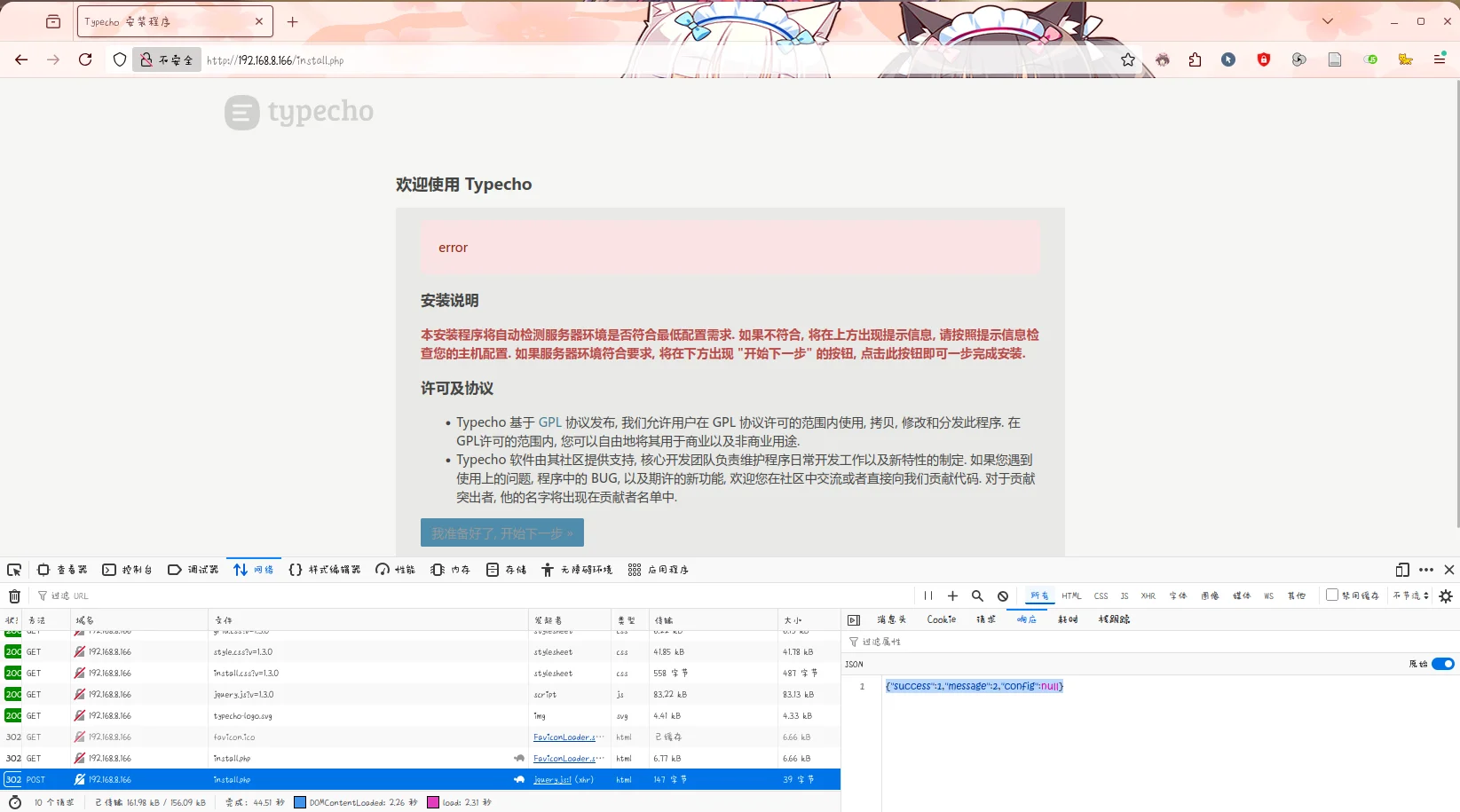
ChatGPT 建议我尝试一下在 URL 后面加上 ?step=2 强制跳转下一步,确实可以到下一步,但是点击开始安装依然 error: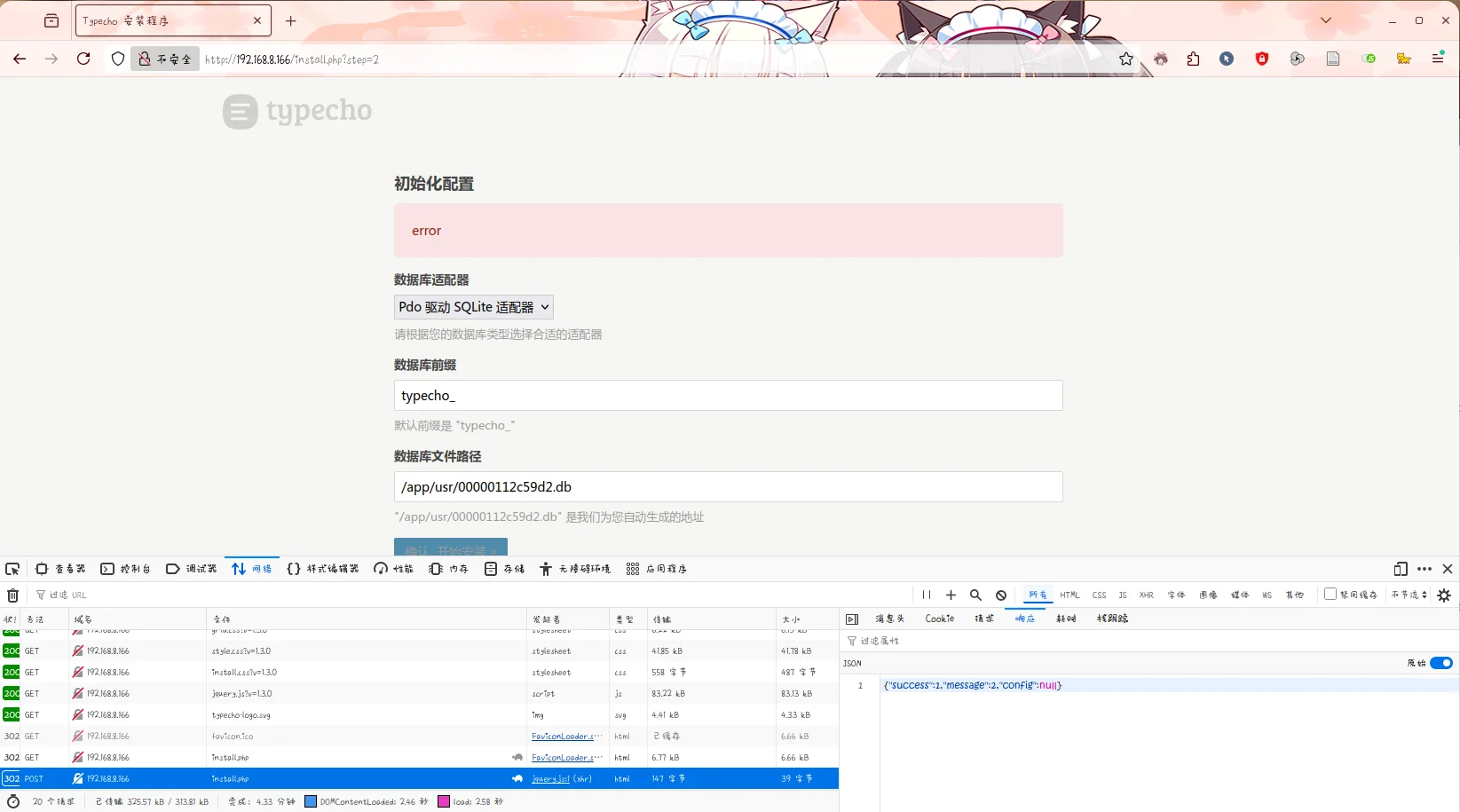
依旧是一个 POST 请求,返回 JSON:
{"success":1,"message":2,"config":null}而且两次的 POST 状态码都是 302 ,算了吧,直接让 Codex 修。不过到这里,我已经看到了希望的曙光。
修补 php-esp32
后续我是让 Codex 继续推进这个项目了,不过在前面的折腾中,我也意识到了一个问题:似乎设置 reserve_kb = 2048 不足以充分利用空间,而且好像这个空间默认还是只读的,这对于 Typecho 来说并不合适——因为 Typecho 初始化要创建 config.inc.php 以及 .db 数据库文件,而且后续可能还有附件上传。
于是我就让 Codex 帮忙实现可用空间最大化,并且让网站目录变得可以读写,做了下面的工作:
这次改动都在 toolchains/php-esp32/ 里,共修改 4 个文件,分两类:一类是把嵌入式存储从只读改成可写(构建脚本 + boot.c),一类是让 HTTP 服务器具备真正 Web 服务器该有的路由、安全边界和请求语义(web_server.c)。
CMakeLists.txt
storage 分区的 FAT 镜像生成器要换掉,把:
fatfs_create_rawflash_image(storage "${PHP_EMBED_SRC}" FLASH_IN_PROJECT)改为:
fatfs_create_spiflash_image(storage "${PHP_EMBED_SRC}" FLASH_IN_PROJECT)改动情况: rawflash 生成只读裸 FAT 镜像,spiflash 生成带磨损均衡的可写 FAT 镜像。
原因: 只读镜像没法让 Typecho 写数据库和上传文件;换成 spiflash 才能配合下文 esp_vfs_fat_spiflash_mount_rw_wl 在 Flash 上持久写入。
gen-partitions.cmake
cmake/gen-partitions.cmake 的 app 分区前的预留空间从硬编码改成按启动模式动态计算,把:
# nvs + phy + alignment; secure boot pushes the app to 0x20000 = 128 K, so 128 K is the safe floor).
set(_pre_k 128)
改为:
# nvs + phy + alignment). Normal boot starts at 0x10000; secure boot reserves
# 0x20000. Use the actual prefix so embedded storage can reach the end of flash.
set(_pre_k 64)
if(PHP_SECURE)
    set(_pre_k 128)
endif()
改动情况: _pre_k 从固定 128 KiB 改为普通启动 64 KiB、安全启动 128 KiB。
原因: 原版一律按安全启动预留,普通启动下白白浪费 64 KiB。按实际前置偏移计算后,storage 分区能多占到 Flash 末尾的 64 KiB。
boot.c
main/boot.c 改动最多,主要是把 /app 从只读挂载改成可写 FAT+WL,再补上 Typecho 需要的 ini 默认值。
1.mount_embedded() 改用可写 WL 挂载
原版:
/* Mount the optional embedded PHP source: a read-only FAT image in the internal
 * 'storage' partition. Absent on microSD-only firmware (the partition may not exist, or
 * exist but hold no image) -- in which case this returns false and we run from the SD. */
static bool s_app_mounted;

static bool mount_embedded(void)
{
    const esp_partition_t *p = esp_partition_find_first(
        ESP_PARTITION_TYPE_DATA, ESP_PARTITION_SUBTYPE_DATA_FAT, "storage");
    if (!p) {
        return false;
    }
    esp_vfs_fat_mount_config_t cfg = { .max_files = 5 };
    if (esp_vfs_fat_spiflash_mount_ro(APP_MOUNT_POINT, "storage", &cfg) != ESP_OK) {
        return false;
    }
    s_app_mounted = true;
    return true;
}
适配版:
/* Mount the optional embedded PHP source as a writable FAT filesystem with wear
 * levelling on the internal 'storage' partition.
 *
 * WARNING: The partition must be provisioned with fatfs_create_spiflash_image().
 * The old fatfs_create_rawflash_image() is incompatible with this mount method.
 * Keep auto-format DISABLED: a failed mount must never silently delete Typecho data.
 */
static bool s_app_mounted;
static wl_handle_t s_app_wl = WL_INVALID_HANDLE;

static bool mount_embedded(void)
{
    const esp_partition_t *p = esp_partition_find_first(
        ESP_PARTITION_TYPE_DATA, ESP_PARTITION_SUBTYPE_DATA_FAT, "storage");
    if (!p) {
        ESP_LOGW(TAG, "no embedded 'storage' partition found");
        return false;
    }

    const esp_vfs_fat_mount_config_t cfg = {
        .format_if_mount_failed = false, /* Do NOT erase the user's DB/uploads. */
        .max_files = 16,                 /* PHP + SQLite may open several files. */
        .allocation_unit_size = 4096,
    };

    esp_err_t err = esp_vfs_fat_spiflash_mount_rw_wl(
        APP_MOUNT_POINT, "storage", &cfg, &s_app_wl);
    if (err != ESP_OK) {
        ESP_LOGE(TAG,
                 "failed to mount writable /app (%s): check storage image / WL format",
                 esp_err_to_name(err));
        s_app_wl = WL_INVALID_HANDLE;
        return false;
    }

    s_app_mounted = true;
    uint64_t total_bytes = 0, free_bytes = 0;
    if (esp_vfs_fat_info(APP_MOUNT_POINT, &total_bytes, &free_bytes) == ESP_OK) {
        ESP_LOGI(TAG, "site filesystem: %lu KiB total, %lu KiB free",
                 (unsigned long)(total_bytes / 1024), (unsigned long)(free_bytes / 1024));
    }
    ESP_LOGI(TAG, "writable embedded FAT+WL mounted at %s (%lu KiB partition)",
             APP_MOUNT_POINT, (unsigned long)(p->size / 1024));
    return true;
}
改动情况: 挂载 API 从 esp_vfs_fat_spiflash_mount_ro 换成 esp_vfs_fat_spiflash_mount_rw_wl,新增 wl_handle_t 句柄;format_if_mount_failed = false,max_files 从 5 提到 16,allocation_unit_size = 4096;挂载成功后打印总容量和可用容量。
原因: Typecho 要往 /app 写 SQLite 数据库、usr/uploads 和会话文件,只读挂载根本跑不起来。format_if_mount_failed=false 是关键安全开关——自动格式化会静默擦掉用户的数据库和上传,绝对不能开。max_files=16 容纳 PHP 同时打开多个模板、插件和数据库文件。
2.新增 typecho ini 默认值钩子
/* TYPECHO_ESP32_HTTP_PATCH_V1: set writable upload/session temp locations.
 * These PHP_INI_SYSTEM values must be seeded before php_embed_init(). */
static void typecho_ini_default(HashTable *ht, const char *key, const char *val)
{
    zval z;
    ZVAL_NEW_STR(&z, zend_string_init(val, strlen(val), 1));
    zend_hash_str_update(ht, key, strlen(key), &z);
}

static void typecho_ini_defaults(HashTable *ht)
{
    typecho_ini_default(ht, "upload_tmp_dir", APP_MOUNT_POINT "/usr/tmp");
    typecho_ini_default(ht, "sys_temp_dir", APP_MOUNT_POINT "/usr/tmp");
    typecho_ini_default(ht, "session.save_path", APP_MOUNT_POINT "/usr/sessions");
    typecho_ini_default(ht, "upload_max_filesize", "512K");
    typecho_ini_default(ht, "post_max_size", "768K");
#ifdef PHP_EXT_OPCACHE_ENABLED
    opcache_ini_defaults(ht);
#endif
}
改动情况: 新增 typecho_ini_defaults 钩子,注入 5 个 INI 默认值,并复用 opcache_ini_defaults。
原因: 嵌入式 SAPI 没有 php.ini,上传和会话的临时目录默认指向不可写位置,Typecho 后台上传和登录会话全都会失败。这里把 upload_tmp_dir/sys_temp_dir/session.save_path 全部指到可写的 /app/usr/tmp 与 /app/usr/sessions,上传和 POST 上限收到 512K/768K 以匹配 PSRAM 缓冲能力。
3.boot_php_runtime() 创建临时目录并安装 ini 钩子
原版:
php_embed_module.ub_write = esp_ub_write;适配版:
    /* Create session and upload temp dirs on the writable Flash mount. */
    if (s_app_mounted) {
        mkdir(APP_MOUNT_POINT "/usr", 0755);
        mkdir(APP_MOUNT_POINT "/usr/tmp", 0755);
        mkdir(APP_MOUNT_POINT "/usr/sessions", 0755);
    }
    php_embed_module.ub_write = esp_ub_write;
    php_embed_module.ini_defaults = typecho_ini_defaults;
改动情况: /app 挂载后先 mkdir 出 usr、usr/tmp、usr/sessions 三个目录,再把 ini_defaults 钩子设为 typecho_ini_defaults。
原因: INI 里指向的目录必须真实存在,PHP 上传和会话才不会报错;钩子必须在 php_embed_init 读取 INI 之前装好。另外两个 OPcache 分支里的 opcache_ini_defaults 也一并换成了 typecho_ini_defaults(后者内部会调 opcache_ini_defaults),让上传/会话 INI 和 OPcache INI 在同一次钩子调用里一起生效。
4.卸载改为可写 WL 卸载
原版:
    if (s_app_mounted) {
        esp_vfs_fat_spiflash_unmount_ro(APP_MOUNT_POINT, "storage");
    }
适配版:
    if (s_app_mounted) {
        esp_err_t err = esp_vfs_fat_spiflash_unmount_rw_wl(APP_MOUNT_POINT, s_app_wl);
        if (err != ESP_OK) {
            ESP_LOGE(TAG, "failed to unmount writable /app: %s", esp_err_to_name(err));
        } else {
            s_app_mounted = false;
            s_app_wl = WL_INVALID_HANDLE;
        }
    }
改动情况: 卸载 API 配合挂载改为 esp_vfs_fat_spiflash_unmount_rw_wl,传入 WL 句柄并处理错误、复位状态。
原因: 挂载和卸载必须成对使用同一族 API,否则 WL 句柄泄漏。
web_server.c
main/models/web_server.c 这个文件改的是 HTTP 服务器本身。原版基本是把请求一股脑丢给 index.php,静态文件无差别地直出,对 Typecho 来说既跑不了安装器/后台子页面,又有把数据库和配置文件直接下载下来的风险。改动围绕路由分发和安全边界展开。
1.按路由选择入口脚本
原版:
static char s_docroot[256]; php_register_variable("SCRIPT_NAME", "/index.php", arr);
php_register_variable("PHP_SELF", "/index.php", arr);
php_register_variable("SCRIPT_FILENAME", (char *) s_web_script, arr);适配版:
static char s_docroot[256];
/* TYPECHO_ESP32_HTTP_PATCH_V1: per-request script selection. Only trusted routes are executable. */
static char s_route_script[512];
static char s_route_name[1024];
php_register_variable("SCRIPT_NAME", s_route_name, arr);
php_register_variable("PHP_SELF", s_route_name, arr);
php_register_variable("SCRIPT_FILENAME", s_route_script, arr);并新增 web_select_script(),默认路由到 index.php,仅当请求是 /install.php 或 /admin/<单段>.php(无子目录、无 ../\、文件真实存在)时才切到对应文件:
static void web_select_script(void)
{
    snprintf(s_route_script, sizeof(s_route_script), "%s", s_web_script);
    snprintf(s_route_name, sizeof(s_route_name), "/index.php");
    const char *path = s_req.path;
    if (!strcmp(path, "/admin/")) path = "/admin/index.php";
    bool is_install = !strcmp(path, "/install.php");
    bool is_admin = !strncmp(path, "/admin/", 7) && path[7] != '\0'
                 && strchr(path + 7, '/') == NULL;
    size_t n = strlen(path);
    if (!is_install && !(is_admin && n >= 4 && !strcasecmp(path + n - 4, ".php"))) return;
    if (strstr(path, "..") || strchr(path, '\\')) return;
    char candidate[sizeof(s_route_script)];
    int written = snprintf(candidate, sizeof(candidate), "%s%s", s_docroot, path);
    if (written <= 0 || written >= (int) sizeof(candidate)) return;
    struct stat st;
    if (stat(candidate, &st) != 0 || !S_ISREG(st.st_mode)) return;
    snprintf(s_route_script, sizeof(s_route_script), "%s", candidate);
    snprintf(s_route_name, sizeof(s_route_name), "%s", path);
}
改动情况: SCRIPT_NAME/PHP_SELF/SCRIPT_FILENAME 从硬编码 /index.php 改为按请求选定的 s_route_name/s_route_script;web_select_script() 严格限定只有安装器和 admin/ 顶层 PHP 才直接执行,其余一律走 index.php。
原因: Typecho 安装器走 /install.php、后台走 /admin/index.php,硬编码 /index.php 会让这些入口拿不到正确的自身路径,重定向和相对资源链接全错乱;同时严格限定可执行面,禁止 /var/、嵌套插件 PHP、config.inc.php 被远程执行。
2.静态资源白名单与内部路径 403
原版: web_try_static() 直接按路径找文件直出,无任何过滤。
适配版: 新增 web_is_public_asset() 和 web_is_internal_path() 两个判定函数:
static bool web_is_public_asset(const char *path)
{
    if (!path || path[0] != '/' || strstr(path, "..") || strchr(path, '\\')) return false;
    if (!strcmp(path, "/favicon.ico") || !strcmp(path, "/robots.txt")) return true;
    static const char *const roots[] = {
        "/admin/css/", "/admin/js/", "/admin/img/", "/admin/images/", "/admin/fonts/",
        "/usr/themes/", "/usr/plugins/", "/usr/uploads/"
    };
    bool in_public_dir = false;
    for (size_t i = 0; i < sizeof(roots) / sizeof(roots[0]); i++) {
        if (!strncmp(path, roots[i], strlen(roots[i]))) {
            in_public_dir = true;
            break;
        }
    }
    if (!in_public_dir) return false;
    if (strstr(path, "/.")) return false;
    const char *dot = strrchr(path, '.');
    if (!dot) return false;
    /* Uploaded assets can be public, but never serve scripts or active SVG/JS there. */
    if (!strncmp(path, "/usr/uploads/", 13)) {
        static const char *const upload_exts[] = {
            ".png", ".jpg", ".jpeg", ".gif", ".webp", ".avif", ".pdf"
        };
        for (size_t i = 0; i < sizeof(upload_exts) / sizeof(upload_exts[0]); i++) {
            if (!strcasecmp(dot, upload_exts[i])) return true;
        }
        return false;
    }
    static const char *const exts[] = {
        ".css", ".js", ".mjs", ".map", ".png", ".jpg", ".jpeg", ".gif",
        ".webp", ".svg", ".ico", ".woff", ".woff2", ".ttf", ".eot",
        ".avif", ".webm", ".mp4", ".pdf"
    };
    for (size_t i = 0; i < sizeof(exts) / sizeof(exts[0]); i++) {
        if (!strcasecmp(dot, exts[i])) return true;
    }
    return false;
}

static bool web_is_internal_path(const char *path)
{
    if (!path || path[0] != '/') return true;
    if (strstr(path, "..") || strchr(path, '\\') || strstr(path, "/.")) return true;
    if (!strcmp(path, "/config.inc.php") || !strcmp(path, "/init.php")) return true;
    if (!strncmp(path, "/var/", 5) || !strncmp(path, "/install/", 9)) return true;
    if (!strncmp(path, "/usr/", 5) && !web_is_public_asset(path)) return true;
    return false;
}
web_try_static() 入口加白名单守卫,web_handle() 里对内部路径直接 403:
static bool web_try_static(httpd_req_t *req)
{
    const char *path = s_req.path;
    if (!web_is_public_asset(path)) return false;
    // ...
web_split_uri();
if (web_is_internal_path(s_req.path)) {
httpd_resp_send_err(req, HTTPD_403_FORBIDDEN, "Forbidden");
return ESP_OK;
}
web_select_script();改动情况: web_is_public_asset 只放行 /admin/{css,js,img,...}/、/usr/themes/、/usr/plugins/、/usr/uploads/ 下指定扩展名的静态资源,/usr/uploads/ 仅放行图片/PDF;web_is_internal_path 把 config.inc.php、init.php、/var/、/install/ 以及 /usr/ 下非公开资源一律判为内部路径,请求直接返回 403。
原因: 原版会把 /app 下任意存在的文件送出去,意味着 SQLite 数据库、config.inc.php、备份文件都能被远程下载。白名单把可服务面收窄到主题/插件/上传里的静态资源,杜绝敏感文件泄露。
3.设置 server_context 启用 POST/cookie 解析
原版:
SG(request_info).request_method = s_req.method_str;适配版:
    /* A real server context enables SAPI POST parsing and read_cookies. Embed
     * leaves this NULL, which silently makes every form look empty. */
    SG(server_context) = s_web_req;
    SG(sapi_headers).http_response_code = 200;
    SG(request_info).request_method = s_req.method_str;
改动情况: 设置 SG(server_context) = s_web_req 并把响应码初始化为 200。
原因: embed SAPI 默认 server_context 为 NULL,导致 SAPI 的 POST 解析和 cookie 读取被跳过,Typecho 后台所有表单提交都是空数据。设上 httpd 请求句柄后 SAPI 才会真正读 body。
4.缺省 Content-Type 采用 SAPI 声明的 MIME
原版:
    if (!have_ctype) {
        httpd_resp_set_type(s_web_req, "text/html; charset=UTF-8");
    }
适配版:
    if (!have_ctype) {
        snprintf(s_ctype_hdr, sizeof(s_ctype_hdr), "%s",
            (h->mimetype && h->mimetype[0]) ? h->mimetype : "text/html; charset=UTF-8");
        httpd_resp_set_type(s_web_req, s_ctype_hdr);
    }
改动情况: PHP 没显式发 Content-Type 时,优先用 SAPI 记录的 h->mimetype,仍无则回退 text/html; charset=UTF-8。
原因: 和 PHP 侧 Response.php 的强制覆盖配合,确保 JSON 等响应的 MIME 正确传给浏览器/jQuery,而不是一律被当成 text/html。
5.POST body 限流
原版: 无 body 大小检查。
适配版:
    /* Limit request-body buffering in the 8 MiB PSRAM system. */
    if (req->content_len > 786432) {
        httpd_resp_set_status(req, "413 Payload Too Large");
        httpd_resp_set_type(req, "text/plain; charset=UTF-8");
        httpd_resp_send(req, "POST body exceeds 768 KiB", HTTPD_RESP_USE_STRLEN);
        return ESP_OK;
    }
改动情况: POST body 超过 768 KiB 直接返回 413。
原因: N16R8 只有 8 MiB PSRAM,放任大 body 上传会直接 OOM。768 KiB 和 ini 里的 post_max_size 对齐。
6.异常日志钩子 + 改由 php_request_shutdown 发头
原版:
static void web_serve_one(void)
{
    s_web_len = 0;
    web_prepare_request();
    if (php_request_startup() == SUCCESS) {
        zend_try {
            run_php_file(s_web_script);
        } zend_catch {
        } zend_end_try();
        if (!SG(headers_sent)) {
            sapi_send_headers();
        }
        php_request_shutdown(NULL);
    }
}
适配版:
/* Keep framework-caught PHP errors visible on the serial console. */
static void web_log_exception(zend_object *exception)
{
    zval rv;
    zval *message = zend_read_property(exception->ce, exception,
                                      "message", sizeof("message") - 1, true, &rv);
    if (message && Z_TYPE_P(message) == IS_STRING) {
        ESP_LOGE(TAG, "%s: %s", ZSTR_VAL(exception->ce->name), Z_STRVAL_P(message));
    }
}

static void web_serve_one(void)
{
    s_web_len = 0;
    zend_throw_exception_hook = web_log_exception;
    web_prepare_request();
    if (php_request_startup() == SUCCESS) {
        zend_try {
            run_php_file(s_route_script);
        } zend_catch {
        } zend_end_try();
        /* Shutdown first flushes user output buffers. Typecho sets its final status,
         * MIME type and cookies in an ob_start callback; sending headers before
         * that callback freezes the defaults and breaks redirects / AJAX / login.
         * php_output_deactivate also sends headers for an empty response. */
        php_request_shutdown(NULL);
    }
}
改动情况: 新增 web_log_exception 装到 zend_throw_exception_hook,把框架捕获的异常打到串口;执行的脚本从 s_web_script 改为 s_route_script;删掉请求尾手动调的 sapi_send_headers(),改由 php_request_shutdown 触发。
原因: Typecho 在 ob_start 回调里才设置最终的状态码、MIME 和 Cookie,提前调 sapi_send_headers 会把默认值冻结,破坏重定向、AJAX 和登录——这正是之前安装器 POST 一直返回 302 却不跳转的根由。交给 php_request_shutdown 在输出缓冲冲刷后发送才正确。异常钩子则是为了调试:框架 try/catch 吞掉的错误 otherwise 在串口上一点痕迹都不留。
7.启动 SNTP 时间同步
    /* Typecho timestamps and expiring login cookies need wall-clock time after
     * every power cycle. The init script has connected Wi-Fi at this point. */
    esp_sntp_setoperatingmode(SNTP_OPMODE_POLL);
    esp_sntp_setservername(0, "ntp.aliyun.com");
    esp_sntp_init();
改动情况: Web 服务器启动时向 ntp.aliyun.com 轮询同步系统时间。
原因: ESP32 每次上电 RTC 不保留墙钟时间,Typecho 的文章时间戳和登录 Cookie 过期判断都依赖它;Wi-Fi 连上后同步一次 NTP 即可。
这些改动到位之后,Typecho 终于能完整跑完安装、登录后台、发文章了。不过还有个收尾问题:reserve_kb 到底该设多少?下面单独算一下。
调整 reserve_kb
reserve_kb = 8320 是怎么算出来的:板子是 ESP32-S3-N16R8,N16R8 即 16 MiB Flash、8 MiB PSRAM。Flash 一共 16384 KiB,要塞下四部分:前置区(bootloader + 分区表)、固定分区(nvs + phy_init)、factory(固件本体)、storage(Typecho 站点目录)。
构建时 cmake/gen-partitions.cmake 会按下面这条链推 storage 分区大小:
storage_k = ceil_to_64K( 源码占用 + 64K FAT 开销 + reserve_kb ) / 1024
factory_k = ( 16384 - 64 - storage_k - 0 ) 向下对齐到 64K
其中 64 是普通启动的前置偏移 0x10000,phpstore 没启用所以是 0。源码占用按 4 KB 簇向上取整累加 project-src/ 下所有文件,本次构建实测是 2441216 B(约 2384 KiB)。这些数字在构建日志里都打出来了:
-- php-esp32: embedded 'storage' partition = 10816K (source ~2441216 B occupancy + 64K FAT + 8320K reserve)最终生成的分区表 php-typecho/build/partitions.gen.csv:
# Generated by cmake/gen-partitions.cmake -- do not edit; regenerated each build.
# Name,     Type, SubType,  Offset,   Size
nvs,        data, nvs,      ,         24K
phy_init,   data, phy,      ,         4K
factory,    app,  factory,  ,         5440K
storage,    data, fat,      ,         10816K,
所以 reserve_kb = 8320 的推算思路是:16 MiB Flash 里给固件 factory 留 5440 KiB(PHP 引擎 + ESP-IDF + web server 实测够用且有余量),前置和固定分区共约 92 KiB,剩下全给 storage,对齐到 64 KB 后是 10816 KiB;再从 storage 里扣掉源码占用 2384 KiB 和 64 KiB FAT 开销,剩下的就是额外预留:
10816 − 2384 − 64 − 48(对齐填充) = 8320 KiB这 8320 KiB(约 8.1 MiB)就是 storage 分区里真正给 Typecho 写数据库、上传附件和会话文件用的可写空间。把它写进 php-typecho/php-baremetal.config.toml:
[esp32.storage]
microsd = false
reserve_kb = 8320   # extra KB in the flash `storage` partition on top of the source (0 = just fit it)
如果以后源码体积变了,重跑一次构建看日志里的 occupancy,再用 目标 storage 大小 − 源码占用 − 64K FAT 反推一下就能重算 reserve_kb。
压缩 Typecho 代码仓库
修改后的 Typecho 文件夹依然有 1.9MB,而在寸土寸金的 16MB Flash 上面,0.1MB 也至关重要。Typecho 本身代码就有不少的注释,更进一步,我们还可以执行压缩。利用 PHP 自带的 php_strip_whitespace() 就可以完成。
首先进行 PHP 压缩:
#!/bin/bash

SRC="./project-src"
DST="./project-src-min"

mkdir -p "$DST"

find "$SRC" -type f -print0 | while IFS= read -r -d '' file; do
    relative="${file#"$SRC"/}"
    target="$DST/$relative"

    mkdir -p "$(dirname "$target")"

    case "$file" in
        *.php)
            php -w "$file" > "$target"
            ;;
        *)
            cp -p "$file" "$target"
            ;;
    esac
done
这时文件夹大小已经从 1.9MB 变成了 1.5MB,核算后设置 reserve_kb = 8744。
编译,烧录!Typecho 启动!
编译固件:
../tools/phpflash build --clean然后烧录固件:
../tools/phpflash flash -p /dev/ttyACM0打开了浏览器进行 Typecho 的安装: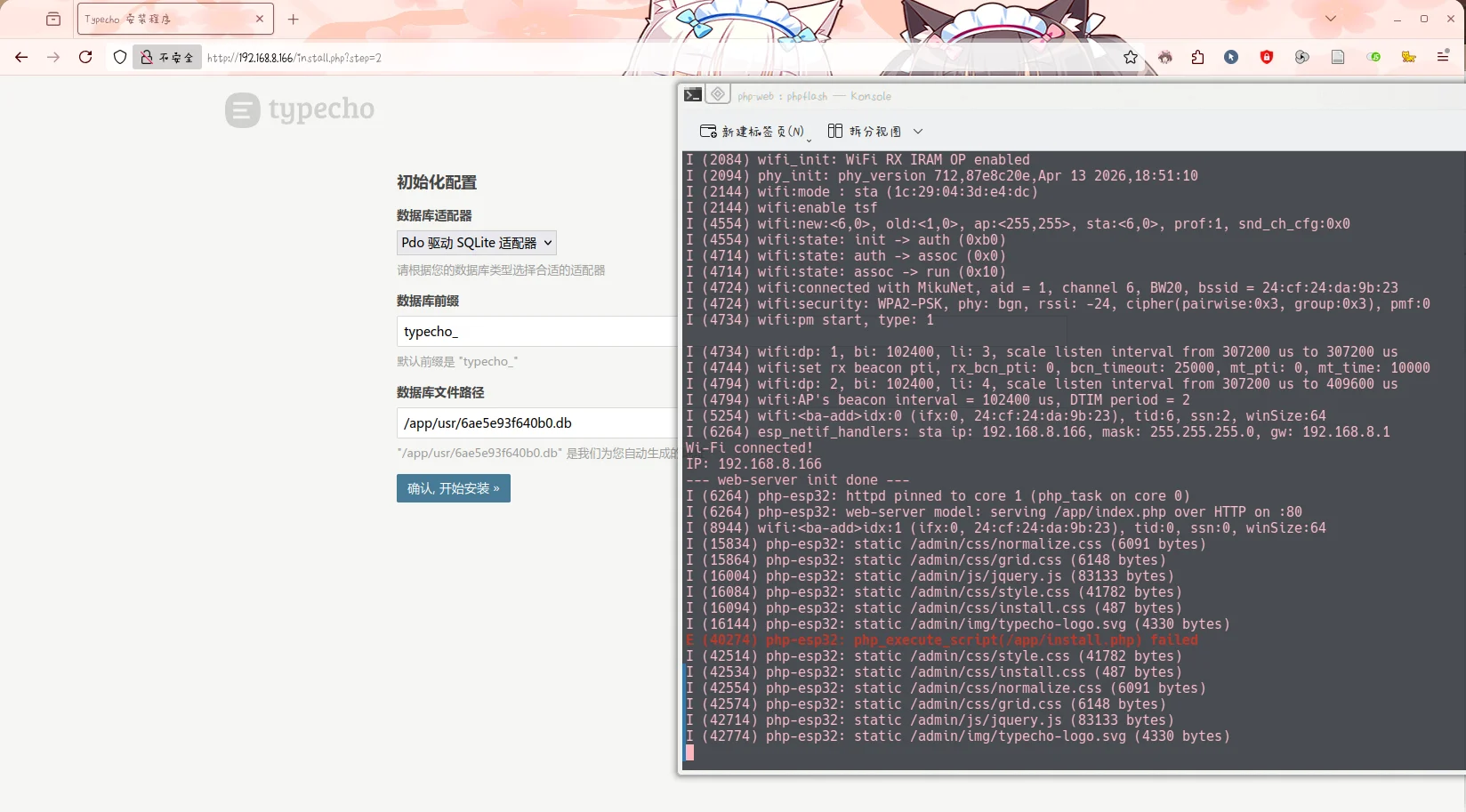
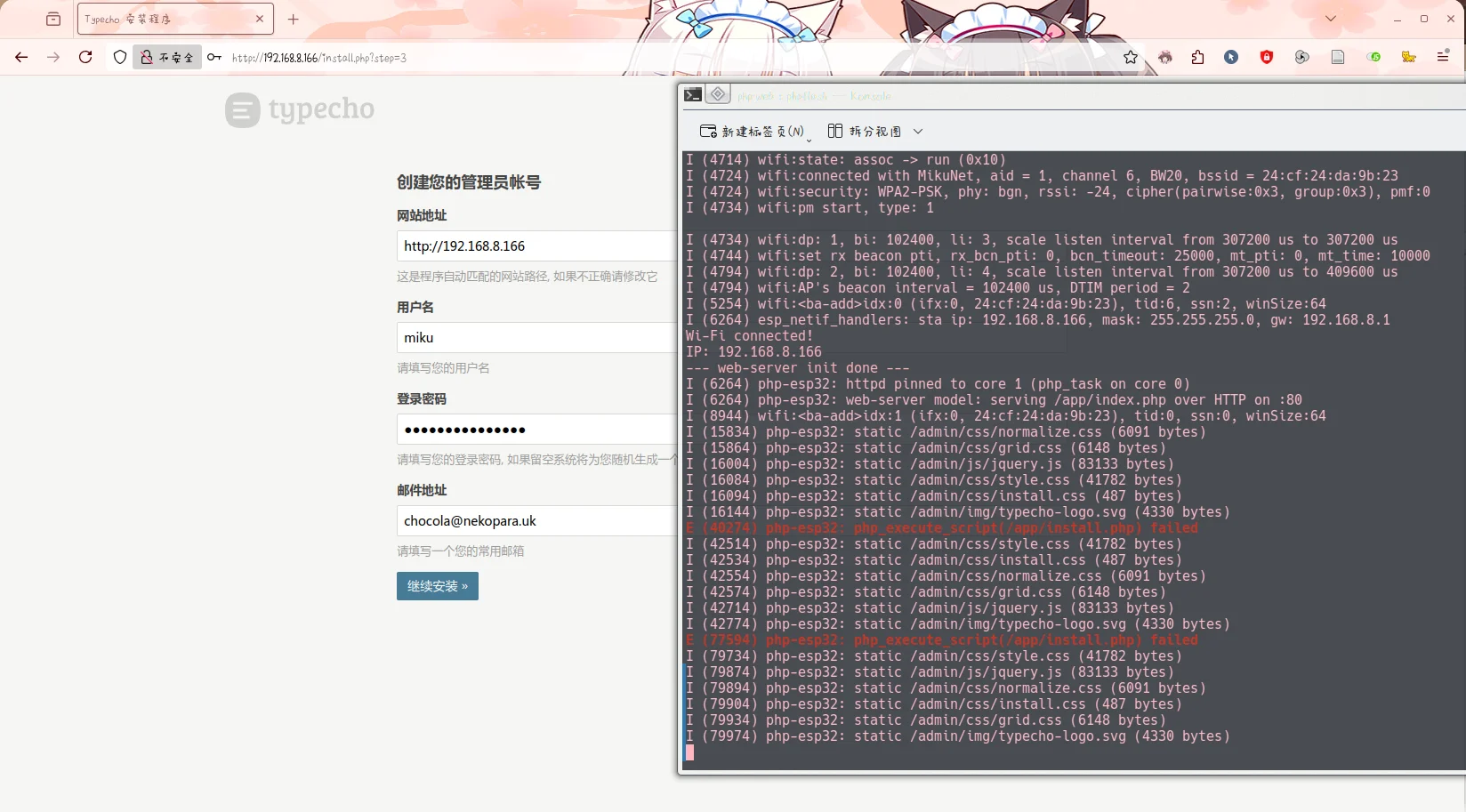
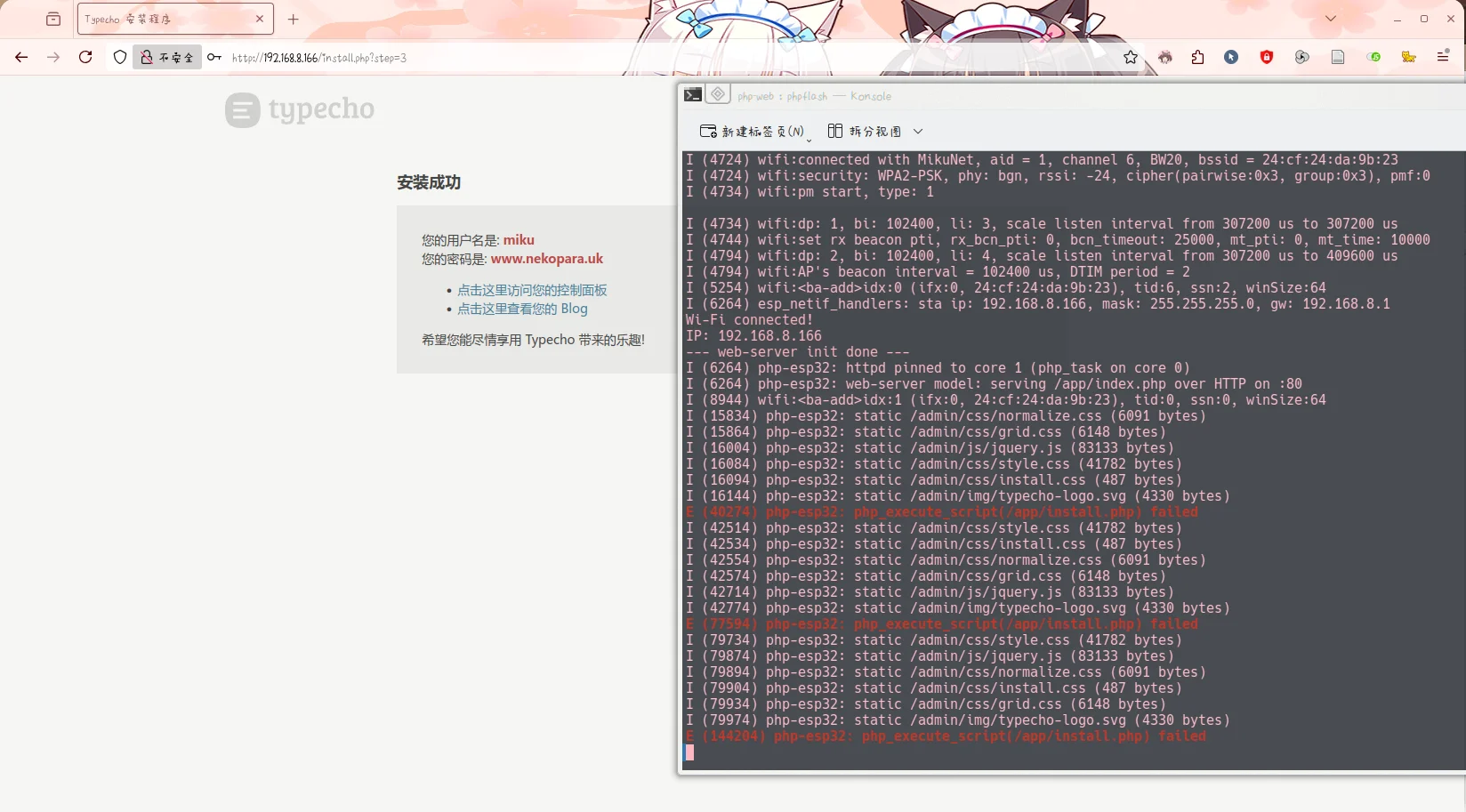
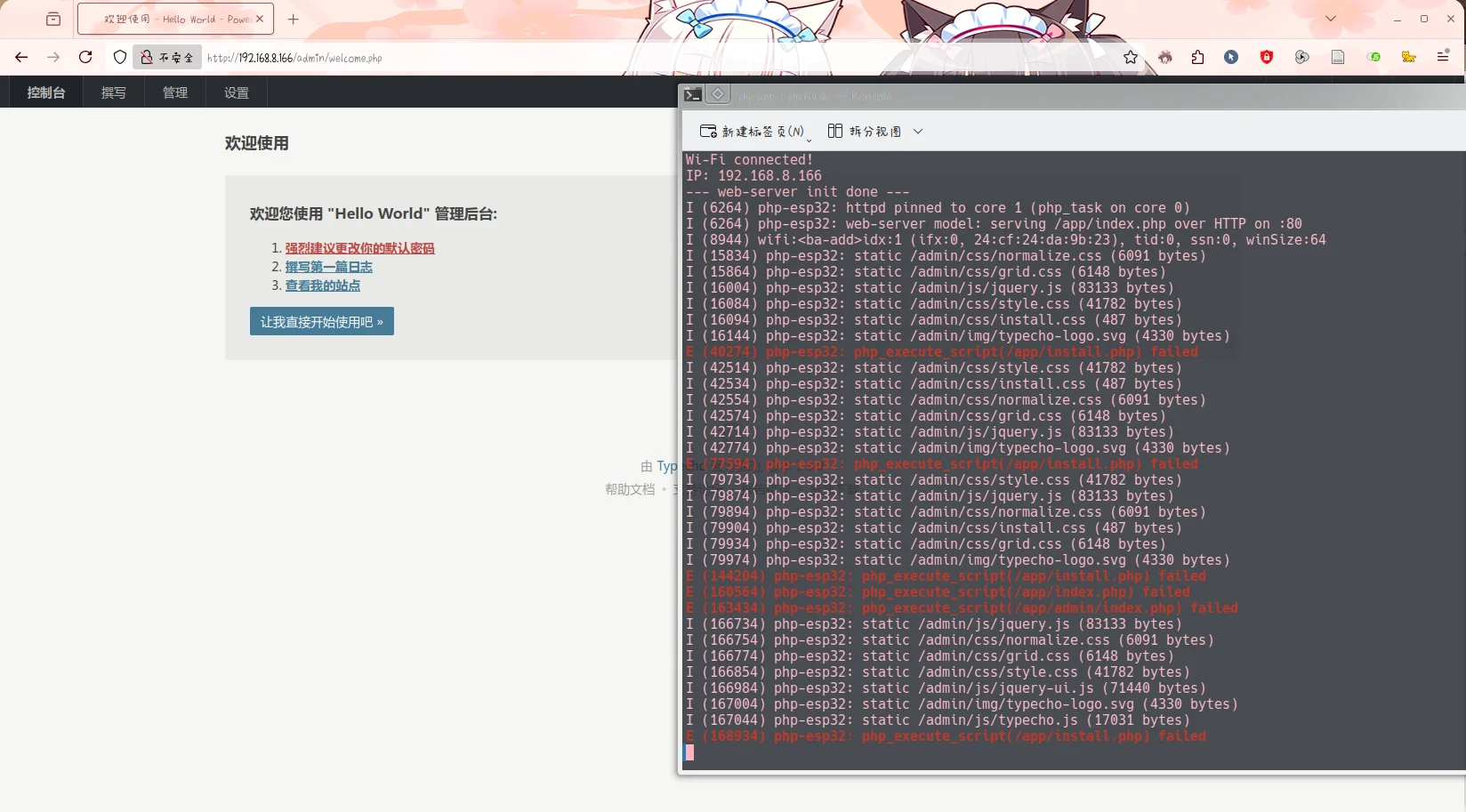
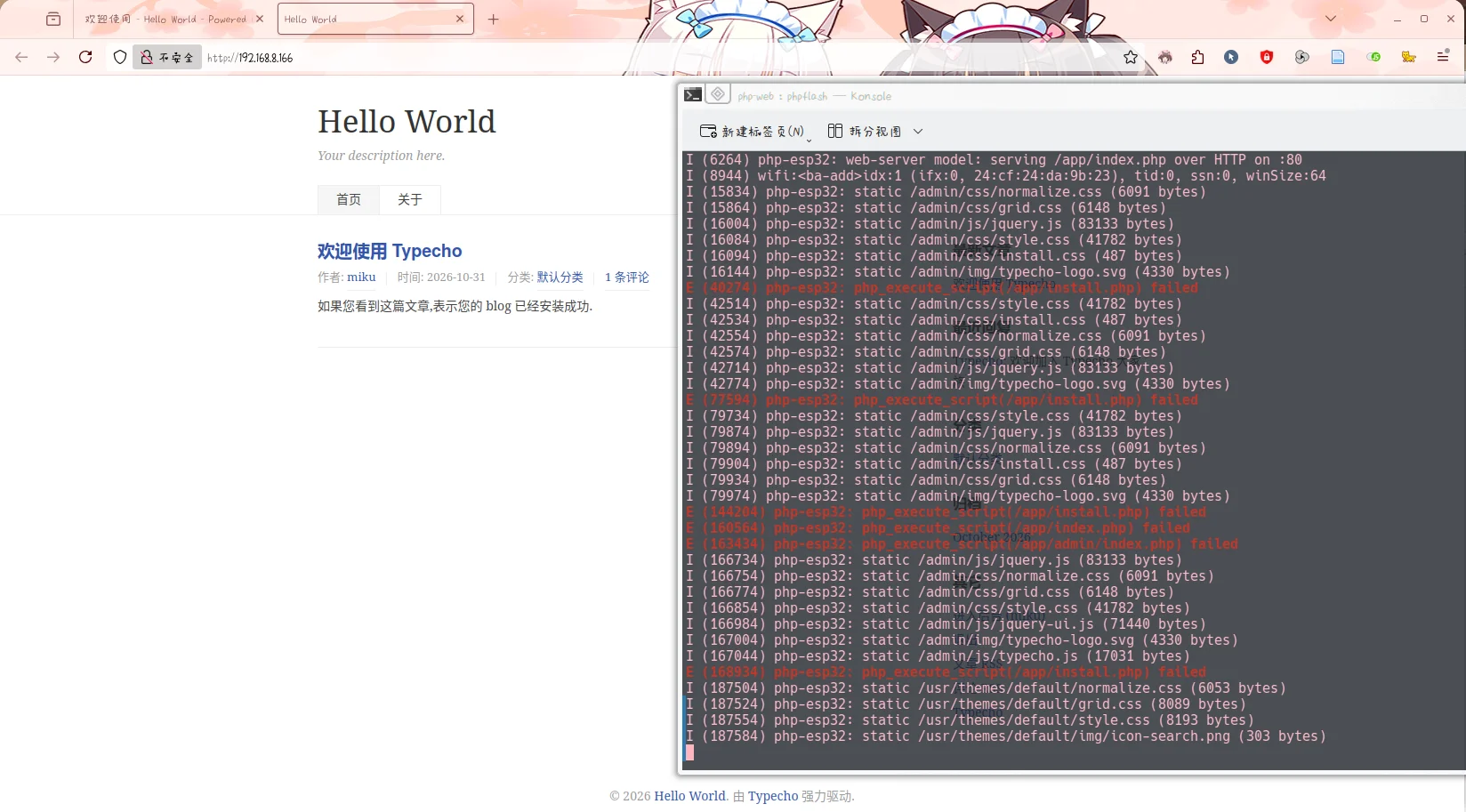
成功了!!!太疯狂了!!!我居然在 ESP32 上面运行起来了 Typecho !!!
我想,对于 ESP32-S3-N16R8 来说,每次访问请求都是一次酣畅淋漓的性能释放吧,毕竟每次点击刷新都要等五六秒,有点像华为畅享的 麒麟710 强行带鸿蒙系统的卡顿感()你永远不知道你的网上邻居在用什么奇葩玩意运行网站

Great article! And above all, impeccable explanation. Just the php-esp32 maintainer. I clearly read the difficulties you had and the brilliant ways you solved them. I will definitely take the advice to make it even better. If you like, in mid-November we will do a general testing round with various volunteers for the release of version 2.0.0 which will be an SDK and will be based on composer. If you want to take part and give your precious advice, write to me.
Wow, I didn't expect the php-esp32 maintainer to find my little blog! 😄
Thank you so much for your kind words, and especially for creating and maintaining such an interesting project!
Getting PHP and even Typecho running on an ESP32-S3 was a really fun experience. I ran into quite a few challenges along the way, but solving them was part of the fun.
I'm really excited to hear about version 2.0.0, especially the move towards an SDK and Composer-based architecture. I'd be happy to participate in the testing round and share my experience and feedback!
What's the best way to get in touch with you about the testing round? GitHub or email?
Looking forward to seeing how php-esp32 evolves. Keep up the great work! ❤️
By the way, I'm really curious how you found my blog post so quickly! I only published it yesterday.
I'm delighted you want to participate, so to get started, send me an email at gianfri@php-baremetal.com with your GitHub username. We'll stay in touch via email. If you prefer more of a chat we can also use discord you can find me in the official php channel my username is always GianfriAur, but we use the private chat so we don't disturb others.After the email I will send you the invitation to read the new phpbm tool repository on github.From there on, just have fun, and if you run into any problems, message me and I'll help you out. Occasionally, I might ask you to run some specific tests. As for how I found you.... Well, simple, I did a query on Google 😅 nothing too fancy
Sounds great! 😄 I'll send you an email with my GitHub username shortly.
I'm really looking forward to trying out the new SDK and seeing how version 2.0.0 develops. I'll be happy to help with testing and share any issues or suggestions I come across!
And haha, I didn't expect Google to index my post so quickly! 😂
Thanks again for the invitation and for your amazing work on php-esp32!